
Mining & Trade News
Malawi Online News
Top Stories
Energy
Energy, mining sectors register highest growth in 2019
February 06, 2020 / Wahard Betha
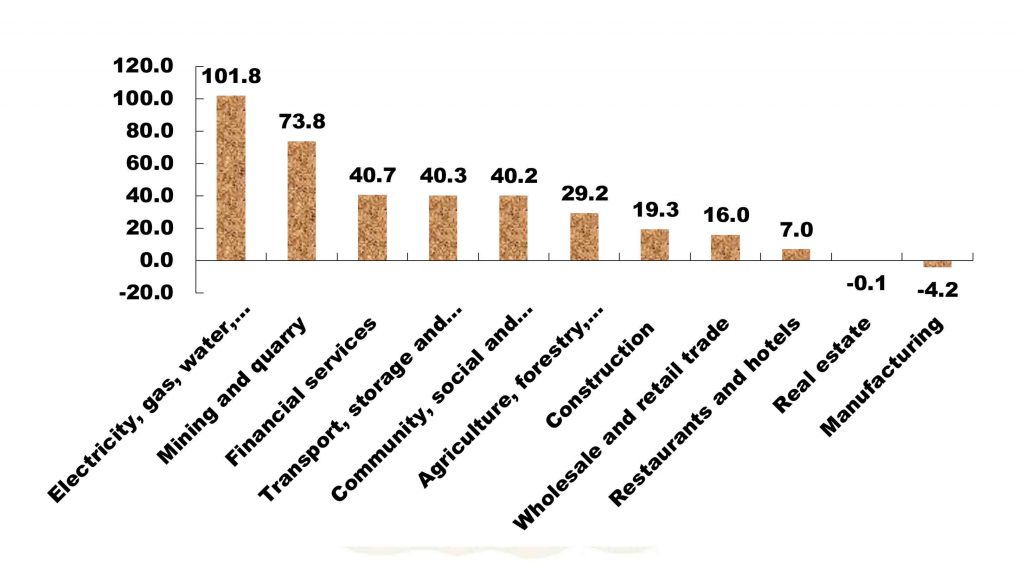
Reserve Bank of Malawi’s (RBM) report released at the first 2020 meeting of the Monetary Policy Committee (MPC) shows that the sectors of energy and mining registered highest growth in the year 2019 due to continued expansion of private sector credit in the country.
The report indicates that the energy sector comprising electricity, gas and water registered 101.8% while mining and quarry registered 73.8% growth.
RBM Governor Dalitso Kabambe says the development was supported by reduction in the interest rates in the country.
Kabambe says: “Private sector credit grew by 21.3% in 2019 compared to 11.5% in 2018. This development was supported by reduction in interest rates. Apart from the traditional borrowers, notable expansions were observed in energy and mining sectors.”
He projects that oil prices in 2020 will remain broadly stable than the past year, with prospects of continued decrease in 2021.
Kabambe says the projection of Brent crude oil prices in 2020 is at average of US$58.0 per barrel compared to US$60.2 of 2019 expected to lower again to US$55.3 in 2021 despite mounting geopolitical tensions.
The report also unveils that real output in 2019 overwhelmingly increased with estimated growth of 5.0% from 4.0% in 2018 following the recovery in the agriculture sector.
“Real Gross Domestic Product (GDP) growth is projected between 5.0 and 6.0% in 2020 owing to further recovery in the agriculture sector as well as favourable macroeconomic conditions,” reads the report.
The report further says the food inflation remained in double digit throughout 2019 and averaged 14.3 percent compared to 9.8 percent in 2018 while non-food inflation remarkably decreased, averaging 5.4 percent in 2019 from an average of 9.0 percent in 2018.
It says the rise in food inflation was mainly driven by increase in maize prices while the decrease in non-food inflation is on account of relatively tight monetary conditions.
The other sectors that performed well in 2019 include: financial services at 40.7%, transport at 40.3%, agriculture and forestry at 29.2%, construction at 19.3%, trade 16.0% and restaurants and hotels at 7.0%.
However, the Kwacha exchange rate has been broadly stable during the past three years and was trading at an average of K738.8731 per US dollar as of December 2019.
The stability of the Kwacha is expected to continue in 2020 on the back of adequate foreign exchange reserves which stood at 4.1 months of imports at the end of December 2019.
During the meeting, (MPC) decided to maintain the Policy Rate at 13.5% and the Lombard Rate at 0.4 percentage points above the Policy Rate.
The Committee also maintained the Liquidity Reserve Requirement (LRR) on local currency deposits at 5%, and the LRR on foreign currency deposits at 3.75%.
The Committee observed that although rising maize prices are likely to continue pushing up headline inflation in the first quarter of 2020, the elevation is deemed temporary and does not pose significant risks to the medium-term inflation outlook.
The global economic growth for 2019 and 2020 have been marked down by 0.1 percentage points to 2.9% and 3.3% from the October 2019 projections of 3.0% and 3.4%, respectively.
The downward revision is on account of surprises to economic activity in some emerging market economies, notably India and social unrest in few other economies
The Reserve Bank of Malawi was established under an Act of Parliament in July 1964 (Chapter 44:02 Laws of Malawi) and started its operations in June, 1965 in Blantyre replacing a branch of the Federal Bank of Rhodesia and Nyasaland founded to serve as a central bank of the Federation of Rhodesia and Nyasaland.
At inception, the Bank had total assets amounting to K15.96 million with foreign assets amounting to K15.2 million an equivalent of £8.8 million, representing 18.1% of the federal currency which was redeemed in Malawi.
Share this:
Leave a Comment
Comments
Mining & Trade Review News

Agribusiness News

Subscribe to Newsletter
Rehabilitation:
The establishment of a stable and self-sustaining ecosystem, but not necessarily the one that existed before mining began. In many cases, complete restoration may be impossible, but successful remediation, reclamation, and rehabilitation can result in the timely establishment of a functional ecosystem.
Archives
Remediation:
The cleanup of the contaminated area to safe levels by removing or isolating contaminants. At mine sites, remediation often consists of isolating contaminated material in pre-existing tailings storage facilities, capping tailings and waste rock stockpiles with clean topsoil, and collecting and treating any contaminated mine water if necessary.
Stackholders Logos


